Navigating 5G and cloud
The recent global rollout of 5G has introduced unprecedented operational complexities for network operators (data volume, velocity, variety, security, and real-time demands). A key challenge is the vast amount of diverse subscriber data across a landscape of legacy 2G/3G/4G and new cloud-native 5G core architectures.
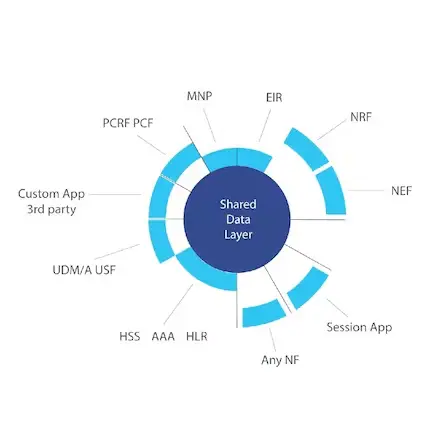
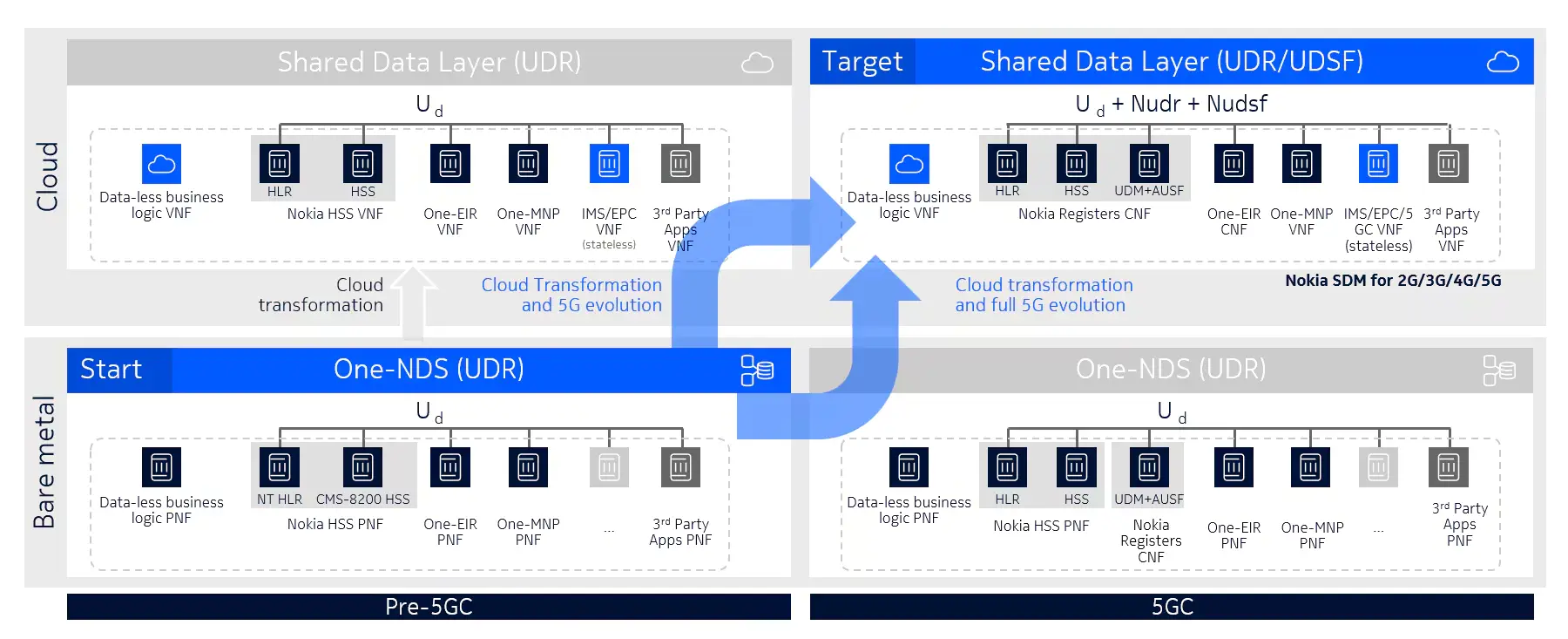
A single, robust repository that stores all subscriber information, ensuring compliance with 3GPP User Data Convergence and 5G standards. The UDR hosts essential applications and guarantees SDM security.
This component enables control applications to store their session data, allowing them to operate in a stateless manner. This improves scalability and resilience.
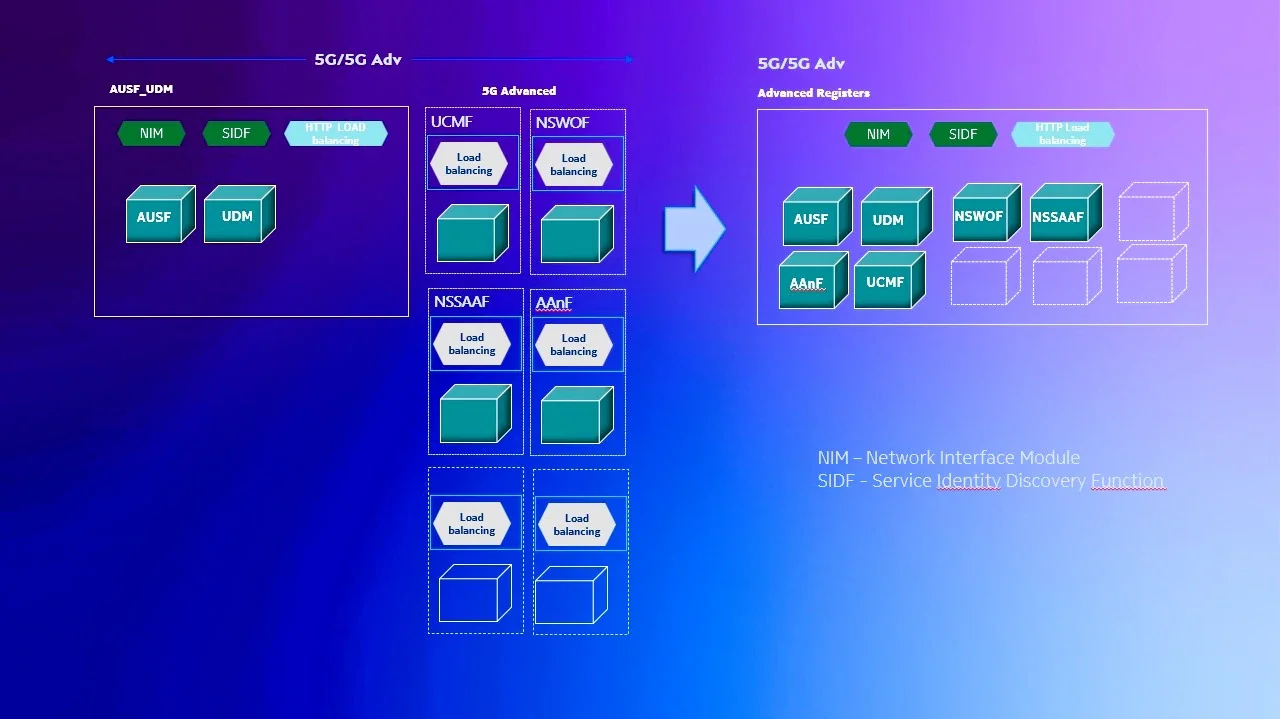
The Unified Data Management (UDM) and Authentication Server Function (AUSF) handle 5G subscriber authorization, registration, and mobility management. Nokia AUSF_UDM offers true cloud-native capabilities for 5G.
The Home Subscriber Server (HSS) and Home Location Register (HLR) manage legacy network access. These interwork seamlessly with the 5G UDM to support domain-spanning use cases and ensure continuous service.
Core capabilities of Nokia Subscriber Data Management
Suite of data and stateless, cloud-native applications, such as Nokia Advanced Registers (NAR), with support for all accesses, all network domains and all IoT verticals, integrated with a common User Data Repository for storing and sharing data.
Highest services availability and robustness due to geo-redundant deployment with separation of service logic and data storage.
Full support of new 5G service-based architecture with service-based interfaces enables a fast introduction of new services and devices.
Unified and real-time data provisioning via single provisioning interface prevents redundant and inconsistent data.
Open and standardized interfaces enable fast 3rd party application integration.
A consolidated view of all subscriber profile data, shared across any application, enables an easy data exposure and monetization.
Automated software delivery, test and deployment via a continuous integration and continuous delivery pipeline accelerates the introduction of new functionality for new services and saves operational cost.
Robust security architecture, featuring telco-level access controls and multi-layer data encryption, ensures data confidentiality and integrity.
With Nokia SDM, user data is centralized in a secure, highly scalable repository. As a single point of provisioning, this saves costs and substantially shortens the time taken to launch new technologies and services or to activate new customers.
The Nokia SDM offers front-end functionalities that use the centralised SDM data, such as Nokia AUSF_UDM (Authentication Server Function and Unified Data Management). The 5G adapted AUSF_UDM architecture is influenced by the cloud-native principles and implements the Service Based Architecture as defined by the 3GPP.
SDM enables a seamless evolution to telco cloud and 5G. Existing 2G/3G/4G subscribers can be migrated to 5G efficiently by provisioning 5G credentials and updating authentication mechanisms. The decoupled SDM architecture allows operators to phase the introduction of 5G front-end applications and backend services, protecting investments while aligning network upgrades with business priorities.
With geo-redundancy and built-in mechanisms, our SDM solution is proven in the field to provide superior reliability. It also offers unparalleled scaling, from small deployments to networks with more than 450+ million subscribers.
Simplify your network and operations with a cost-effective converged solution and single point of provisioning. Whether your customers subscribe to fixed, mobile, cable or Wi-Fi services, or you offer multiple play services across fixed voice, mobile voice, broadband and video services, our SDM solution’s common subscriber data repository helps you achieve the highest operational efficiency.
Our expert teams have the deep experience of network modernization and swaps needed to safely and efficiently upgrade your network in the shortest time. Nokia is the market leader in Subscriber Data Management and we have delivered our solution in more than 130 countries.
Common questions about Nokia Subscriber Data Management
Unified Data Management (UDM) manages network user data in a single, centralized element. The technology is similar to the 4G network's home subscriber service (HSS) but is cloud-native and designed for 5G specifically.
Unified Data Repository (UDR) is a converged repository of subscriber information and can be used to service a number of network functions.
User Data Convergence (UDC) is a 3GPP initiative which seeks to rationalize the databases found across the key mobile technologies such as 2G, 3G, 4G, 5G and IMS.
UDM sometimes also referred to as Unified Data Function (UDF) acts as a front-end to store subscription data for the user in the Unified Data Repository (UDR) and executes essential functions on request from other Network Functions (NFs).
Unstructured Data Storage Function (UDSF) supports in 5G the data storage for stateless network functions. That is, rather than a given network function holding its own storage resources, it will instead store UE context data in the UDSF.
Full specifications for the model
| SKU | - |
|---|
Download product documentation and resources
Explore other configurations and models that might suit your needs.
Recommended
#cloud-operations-manager
Recommended
#nokia-continuous-delivery
NCD is the single unified deployment and automation engine, purpose-built to manage the lifecycle of the entire Nokia Core network portfolio.
Recommended
#cloud-packet-core-cpc
Reach new heights in performance to deliver 5G services with confidence
Our team of experts is ready to help you find the perfect solution for your business needs. Get personalized advice and competitive quotes.
We're here to help with any questions